An Introduction

Last fall, while driving home from work, I listened to an episode of the podcast This is Love (ep 74) about Beatrix Potter and her fascination with Herdwick sheep. I’ll have more to say about Beatrix in a later post, but for now, I want to focus on an interview in the episode with James Rebanks, a shepherd whose family has been raising Herdwick sheep in the Lake District for generations. Noting that the local ecology changed over time because of the work of his ancestors, he argues, “the real history of our landscape should be the history of the nobodies.”
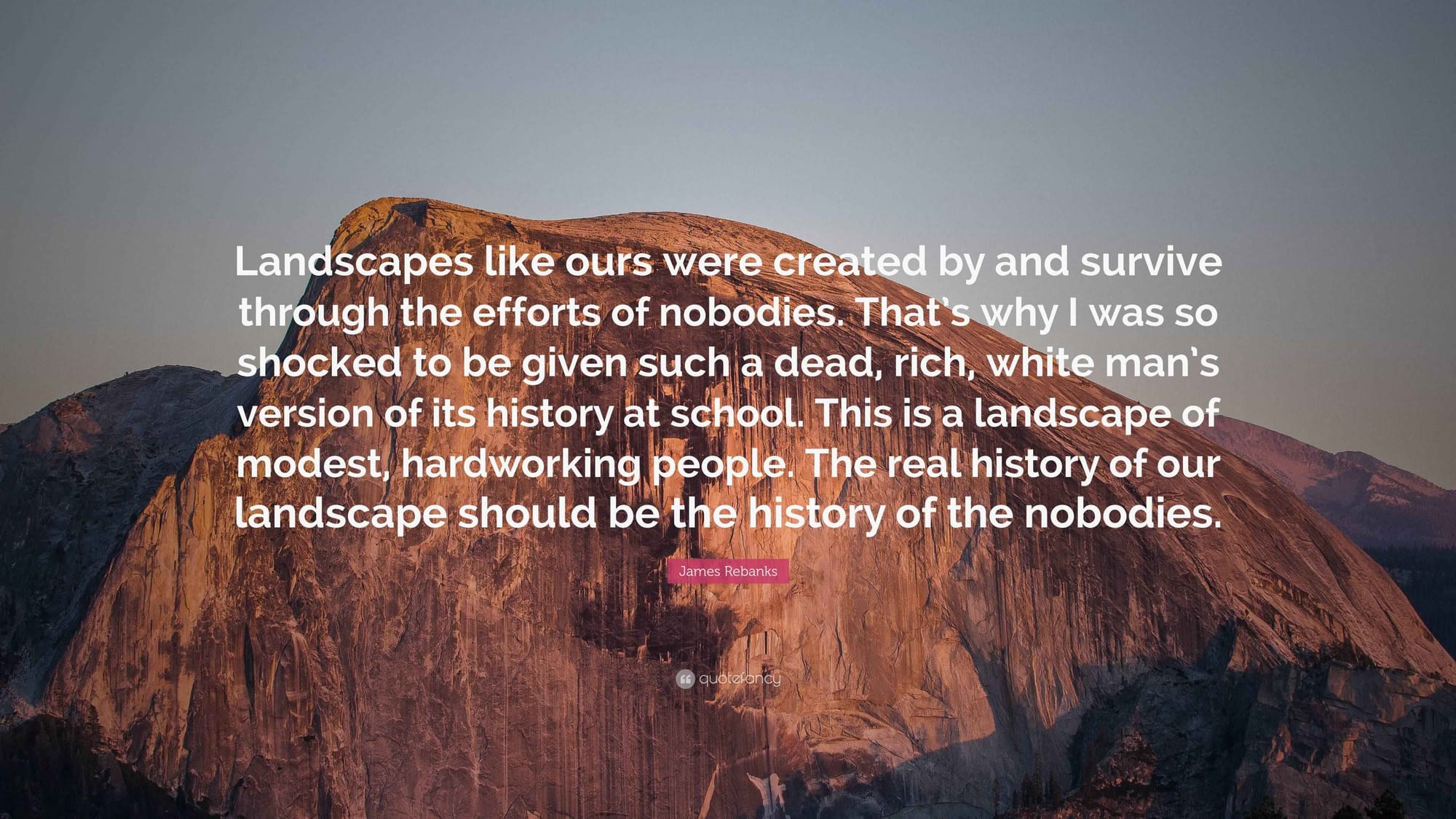
This expression immediately grabbed my attention, especially after Rebanks expounded, “And I didn’t mean it as an insult. I meant it as a compliment.” Our world is built on the work of everyday people, yet their stories are often overlooked or undervalued by society. Until we have a reason to learn more about someone, they remain unknown to us. This is true for historical figures as well as our neighbors. But when we do take the time to find meaning and connection through conversation, reading, or remembering, we are usually rewarded. They become “somebody” to us.
As a history professor, I often work with my students to critically evaluate what it is that our discipline contributes to society. Facts, I argue, are limited by what records have been preserved, whose stories have been prioritized, and how communities collectively interpret them. Given the evolving nature of what is known, it is our responsibility to (re)imagine their significance within the context of our own personal and societal experiences. The shepherd’s plea to pay more attention to the stories of those immediately around us rather than those readily accessible through textbooks struck at the heart of my message and conveyed in a few sentences what I spend semesters trying to articulate.
Laurel Thatcher Ulrich’s famous quote, “Well-behaved women seldom make history” is another example of concisely tapping into deeper questions of who and what we (as a society) choose to remember. In the first chapter of her 2008 book titled after the quote, Ulrich explores the endurance of this phrase since she originally wrote it in 1976 (“Virtuous Women Found: New England Ministerial Literature, 1668-1735” in American Quarterly (Spring 1976)). While some interpret her words as permission to step outside the gendered expectations that society places on women, others see it as a call to dig deeper into the lives of women who have slipped through the (large) cracks in historical records.
Many people think women are less visible in history than men because their bodies impel them to nurture. Their job is to bind the wounds, stir the soup, and bear the children of those whose mission it is to fight wars, rule nations, and define the cosmos. Not all those who make this argument consider women unimportant–on the contrary, they often revere the contributions of women as wives, mothers, and caregivers–or at least they say so. But they also assume that domestic roles haven’t changed much over the centuries, and that women who perform them have no history. (9) (emphasis mine)
Rather than leaving these women behind, Thatcher Ulrich encourages us (scholars, writers, family members, community members) to break away from this assumption, to re-insert the individualized experiences into more nuanced histories, and to restore the history that has eluded many characters in our collective stories. We each have the power to play an active role in reshaping historical narratives, because, as she argues, “History is not just what happened in the past. It is what later generations choose to remember.” (9) Ironically, Thatcher Ulrich's own quote is often misquoted as "Well-behaved women rarely make history" (emphasis mine) because that is how many people choose to remember it.
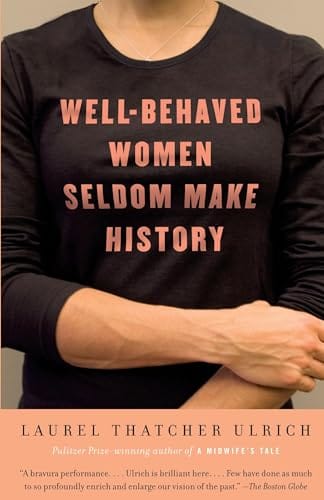
I appreciate Thatcher Ulrich’s analysis for encouraging readers to consider who is doing the work of remembering. And how we as a society are collecting and preserving those stories. For her, what started as a dissertation on bringing Puritan women to life through funeral sermons in the 17th and early 18th centuries grew into a career of looking for women’s stories in unlikely places. Her goal is simple: “not to lament their oppression, but to give them a history.” (11)
I also love that she directly addresses how others might see her work. She argues, “[M]y form of misbehavior has been to care about things that other people find predictable or boring.” (12) When thinking about the stories I want to write in this space, I keep coming back to this quote because the topics I’m interested in may also seem a bit “predictable or boring” at first. Several 20th century writers and educators have attracted my interest lately, and it would not be accurate to describe them as “nobodies.” At the same time, learning more about these individuals at this stage in my life has offered unexpected insights and deeper connections that I look forward to sharing.
Thatcher Ulrich states:
[H]istory is more than an engaging enterprise. It is a primary way of creating meaning. The meaning I found in Martha Ballard’s life had something to do with my own life experience, but perhaps a lot more to do with the collective experiences of a generation of Americans coping with dramatic changes in their own lives. (13) (emphasis mine)
As she concludes, “Well-behaved women make history when they do the unexpected, when they create and preserve records, and when later generations care.” (86)
How do we remember and preserve our own stories? How do we share those stories with our community? And how do we get future generations to care about individuals whose lives initially seem far removed from their own experiences? My goal in starting this blog is to delve into some of these questions while also introducing (or re-introducing) a cast of characters whose historical legacies have become more nuanced and meaningful over time. I hope you'll keep reading.